Voyager 1 seen from Earth, 2023–2025: how fast its distance from us changes
"That's here. That's home. That's us." (Carl Sagan, on the Pale Blue Dot photo Voyager 1 took in 1990, 6 billion km from Earth) Earth's orbit swings its speed from us between 41 and −8 km/s.
What does this axis measure?
Change in distance from Earth (km/s)
What does this axis measure?
Year
Reveal the axesHide the axes
- y ↑
- Change in distance from Earth (km/s)
- x →
- Year
Show the story, the data and the sourceHide the story, the data and the source
The data: 40 points
| Year | Change in distance from Earth (km/s) |
|---|---|
| 2023 | 6.99 |
| 2023.0767 | −2.46 |
| 2023.1534 | −7.3 |
| 2023.2301 | −6.46 |
| 2023.3068 | −0.33 |
| 2023.3836 | 9.53 |
| 2023.4603 | 20.86 |
| 2023.537 | 31.24 |
| 2023.6137 | 38.5 |
| 2023.6904 | 41.06 |
| 2023.7671 | 38.23 |
| 2023.8438 | 30.44 |
| 2023.9205 | 19.36 |
| 2023.9973 | 7.55 |
| 2024.0738 | −2.08 |
| 2024.1503 | −7.18 |
| 2024.2268 | −6.61 |
| 2024.3033 | −0.72 |
| 2024.3798 | 9 |
| 2024.4563 | 20.31 |
| 2024.5328 | 30.79 |
| 2024.6093 | 38.25 |
| 2024.6858 | 41.05 |
| 2024.7623 | 38.48 |
| 2024.8388 | 30.91 |
| 2024.9153 | 19.93 |
| 2024.9918 | 8.09 |
| 2025.0685 | −1.71 |
| 2025.1452 | −7.06 |
| 2025.2219 | −6.78 |
| 2025.2986 | −1.12 |
| 2025.3753 | 8.46 |
| 2025.4521 | 19.75 |
| 2025.5288 | 30.32 |
| 2025.6055 | 37.96 |
| 2025.6822 | 41.03 |
| 2025.7589 | 38.72 |
| 2025.8356 | 31.36 |
| 2025.9123 | 20.49 |
| 2025.989 | 8.63 |
- Ran in puzzle #50 on November 15, 2026. Play it
More like this
-
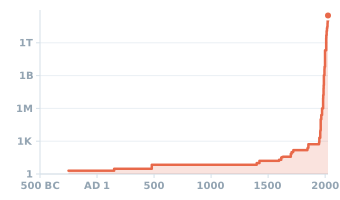 Decimal places of pi known, 250 BC to 2025
Decimal places of pi (count) ↑
Year →
-
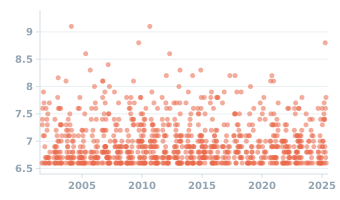 Earthquakes of magnitude 6.6 and up worldwide, 2002–2025
Magnitude ↑
Year →
-
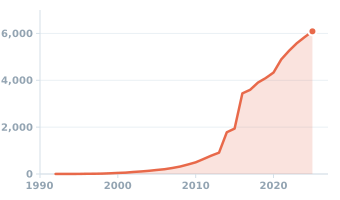 Planets around other stars by year of discovery, running total, 1992–2025
Known exoplanets (count) ↑
Year →
-
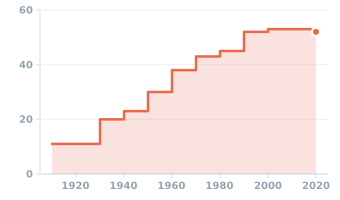 California's seats in the U.S. House after each census since 1910
California's House seats (count) ↑
Year →
-
 Woodland in England as a share of the land, 1086 to 2026
Woodland cover (% of land) ↑
Year →
-
 Girls named Trinity in U.S. Social Security records, 1985–2017
Girls named Trinity (count) ↑
Year →