Carbon-14 left in a sample, by age
Half the carbon-14 is gone after 5,730 years. After 50,000 years, nearly 9 half-lives, only 0.2% is left, which is why radiocarbon dating stops about there.
What does this axis measure?
Carbon-14 remaining (%)
What does this axis measure?
Sample age (years)
Reveal the axesHide the axes
- y ↑
- Carbon-14 remaining (%)
- x →
- Sample age (years)
Show the story, the data and the sourceHide the story, the data and the source
The data: 26 points
| Sample age (years) | Carbon-14 remaining (%) |
|---|---|
| 0 | 100 |
| 2,000 | 78.51 |
| 4,000 | 61.64 |
| 6,000 | 48.39 |
| 8,000 | 37.99 |
| 10,000 | 29.83 |
| 12,000 | 23.42 |
| 14,000 | 18.39 |
| 16,000 | 14.44 |
| 18,000 | 11.33 |
| 20,000 | 8.9 |
| 22,000 | 6.99 |
| 24,000 | 5.48 |
| 26,000 | 4.31 |
| 28,000 | 3.38 |
| 30,000 | 2.65 |
| 32,000 | 2.08 |
| 34,000 | 1.64 |
| 36,000 | 1.28 |
| 38,000 | 1.01 |
| 40,000 | 0.79 |
| 42,000 | 0.62 |
| 44,000 | 0.49 |
| 46,000 | 0.38 |
| 48,000 | 0.3 |
| 50,000 | 0.24 |
- Ran in puzzle #13 on October 9, 2026. Play it
More like this
-
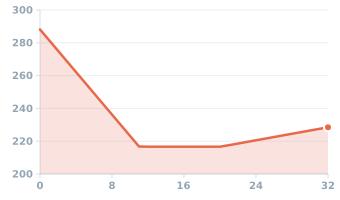 Air temperature by altitude (U.S. Standard Atmosphere)
Air temperature (K) ↑
Altitude (km) →
Air temperature by altitude (U.S. Standard Atmosphere)
Air temperature (K) ↑
Altitude (km) →
-
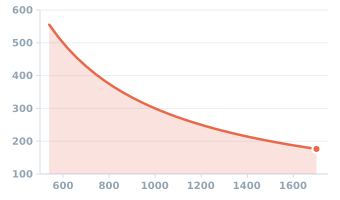 Wavelength of AM radio across the dial
Wavelength (m) ↑
Radio frequency (kHz) →
Wavelength of AM radio across the dial
Wavelength (m) ↑
Radio frequency (kHz) →
-
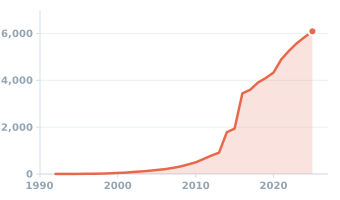 Planets around other stars by year of discovery, running total, 1992–2025
Known exoplanets (count) ↑
Year →
Planets around other stars by year of discovery, running total, 1992–2025
Known exoplanets (count) ↑
Year →
-
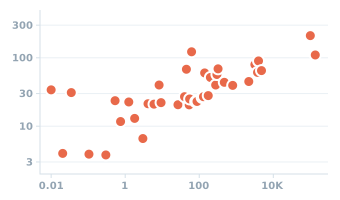 40 mammals: body mass and longest recorded lifespan
Maximum lifespan (years) ↑
Adult body mass (kg) →
40 mammals: body mass and longest recorded lifespan
Maximum lifespan (years) ↑
Adult body mass (kg) →
-
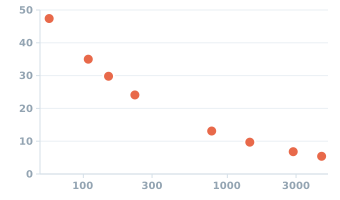 The eight planets: distance from the Sun vs orbital speed
Orbital speed (km/s) ↑
Distance from the Sun (million km) →
The eight planets: distance from the Sun vs orbital speed
Orbital speed (km/s) ↑
Distance from the Sun (million km) →
-
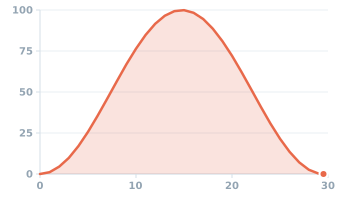 The Moon through an average cycle of its phases: how much of its face is lit
Moon illuminated (%) ↑
Age of the Moon (days) →
The Moon through an average cycle of its phases: how much of its face is lit
Moon illuminated (%) ↑
Age of the Moon (days) →